Italian Vintage Furniture Restoration: Preserving History, Craftsmanship and Value
How professional restoration gives historic Italian furniture a new life without compromising its authenticity
Italian vintage furniture from the 1930s to the 1980s is more than functional design. It represents a period when craftsmanship, industrial production and artistic research developed together. Walnut, teak, veneer, parchment, marble, brass and lacquer were used with techniques that require knowledge of their period. Proper restoration should therefore preserve character, construction, authenticity and usability rather than simply make a piece look new.
The central principle is conservation rather than unnecessary transformation.
Why Professional Assessment Comes First
Every restoration begins with a careful evaluation of the piece and its condition. At La Contessa Arreda, this assessment considers visible defects such as scratches, damaged veneer, loose joints, worn finishes or missing components, but also problems that cannot be immediately seen.
One of the most important hidden issues is the condition of the original glue. Furniture that has survived for decades may appear perfectly stable while its joints have gradually lost cohesion. This is particularly important in chairs, tables, cabinets and other pieces subject to repeated mechanical stress. A restorer must understand how the furniture was originally assembled and how its materials have aged.
Cleaning Vintage Furniture According to Its Age and Materials
Cleaning is not a universal process. Different periods, finishes and materials require different techniques. An aggressive cleaning method can remove original finishes, alter colour, damage veneer or destroy evidence of age that contributes to a piece’s authenticity.
For this reason, cleaning is selected according to the furniture’s construction, finish, materials and historical character. Wood, lacquer, parchment, metal, stone and glass cannot simply be treated in the same way.
For genuinely antique objects, preserving the original patina is often preferable to creating an artificially new appearance. Patina can be part of a piece’s historical identity, recording the passage of time and distinguishing an authentic object from a reproduction. The objective is controlled preservation: removing harmful deposits while retaining the characteristics that should remain.
Structural Restoration: Rebuilding the Furniture from Within
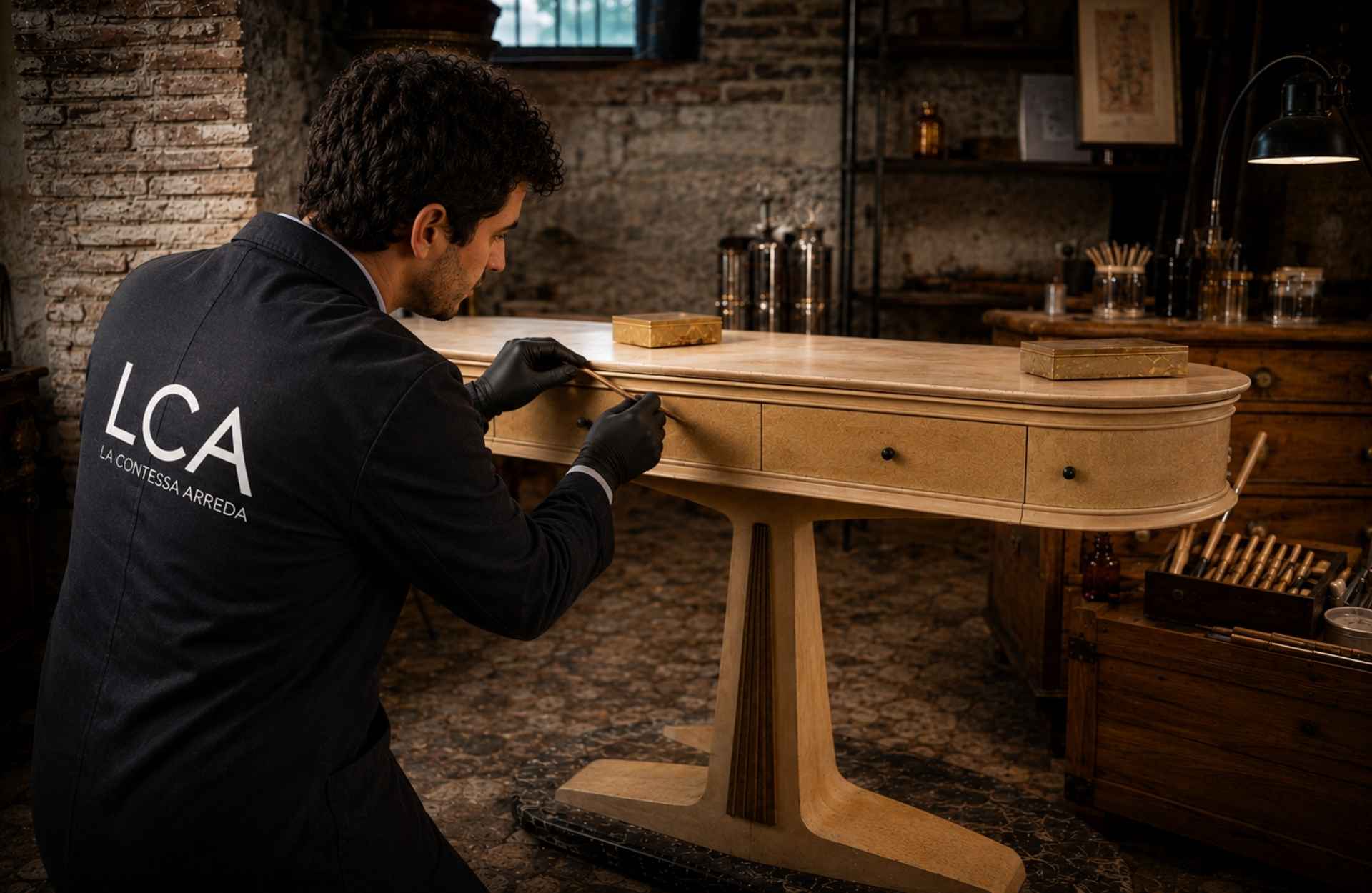
When structural restoration is required, superficial gluing is rarely enough. At La Contessa Arreda’s restoration laboratory, a thorough intervention can involve completely disassembling the relevant parts of a piece, even when the furniture initially appears to need only a minor repair.
Old adhesive can no longer provide reliable cohesion. If new glue is applied over weakened residues, the new joint may not bond correctly, and an uneven repair can cause the furniture to loosen again.
For a durable result, old adhesive must be removed completely from the surfaces to be joined. The parts can then be prepared and reassembled so the new bonding follows the original construction and works harmoniously with the structure.
This distinguishes cosmetic repair from professional restoration: the goal is not to hide a defect but to restore the object’s mechanical integrity.
Replacing Missing Parts Without Losing Authenticity
Once the structure has been stabilised, attention turns to damaged or missing components. This may include reconstructing missing sections, repairing veneer, restoring drawer runners and guides, correcting worn connection points, or rebuilding small structural elements.
The challenge is compatibility with the original furniture without creating an artificial appearance. New material should respect the proportions, grain, colour and construction techniques of the original. In collectible Italian design, restraint is essential because excessive reconstruction can erase traces of history.
The best restoration is not necessarily the one that leaves a piece looking untouched. It is the one that makes the intervention almost invisible while allowing the original design and materials to remain legible.
Restoring the Finish: Every Era Has Its Own Language
The final stage is often the most visually apparent: finishing and polishing. Yet even here there is no single restoration formula.
The correct finish depends on the object’s period, style, wood species, materials and original manufacturing technique. A 1940s cabinet, 1950s walnut table, 1960s teak piece and 1970s lacquered object may require very different approaches.
The aim is to recover depth, protection and visual coherence without creating a historically inappropriate finish. In high-quality Italian vintage furniture, the surface is part of the design, interacting with geometry, light and material.
This is especially important with Italian mid-century furniture, where the relationship between surface, structure and form is often fundamental to the original design. A polished walnut cabinet, for example, communicates something very different from a lacquered 1970s piece or a furniture element finished in parchment.

Restoration and the Value of Italian Vintage Design
For valuable Italian vintage furniture, restoration should always be considered in relation to authenticity. A piece that has been excessively modified may lose some of the qualities that make it collectible, while a carefully restored object can become structurally sound and visually coherent without losing its identity.
This is particularly relevant to Italian mid-century design, whose appeal often lies in the relationship between craftsmanship and innovation. Designers and manufacturers of the period such as Gio Ponti, Osvaldo Borsani, Joe Colombo, Vico Magistretti, and Marco Zanuso experimented with new materials, sculptural forms and industrial techniques while maintaining a strong connection with traditional craftsmanship.
At La Contessa Arreda, the restoration approach is centred on giving furniture a new life while respecting the story already contained in the object. The result should not look like a newly manufactured reproduction. It should look like an authentic piece that has been intelligently cared for and made ready to continue its life.
How to Preserve Restored Vintage Furniture
Once restoration is complete, preservation continues in the home. Vintage furniture should be protected from prolonged direct sunlight, excessive humidity, abrupt temperature changes and unsuitable cleaning products. Surfaces should be cleaned gently and according to their material, while heavy objects should not be placed on delicate veneers, parchment or aged finishes.
The best restoration ultimately balances three things: structural stability, aesthetic authenticity and respect for history.
Italian furniture from the twentieth century was designed to be used, admired and lived with. A sensitive restoration does not freeze that history in the past. It allows the furniture to remain part of contemporary interiors while preserving the craftsmanship, materials and character that made it worth saving in the first place.
FAQ
Before buying Italian vintage furniture, ask the seller:
Does La Contessa Arreda restore vintage and antique furniture on commission?
Yes. La Contessa Arreda offers furniture restoration on commission, working on individual pieces belonging to private clients, collectors and design enthusiasts. Each project begins with an assessment of the furniture’s condition, materials, construction and original finish. The restoration process is then defined according to the characteristics and historical value of the piece.
What types of Italian furniture can La Contessa Arreda restore?
The restoration service can be applied to a wide range of Italian vintage and antique furniture, including cabinets, tables, chairs, armchairs, chests of drawers and other design pieces. Particular attention is given to furniture from the 1930s to the 1980s, including Italian Mid-Century Modern design. The appropriate restoration technique depends on the period, materials, construction methods and condition of each individual piece.
Does furniture restoration remove the original patina?
Not necessarily. For antique and vintage furniture, preserving the original patina can be an important part of maintaining the object’s authenticity and historical character. La Contessa Arreda evaluates each piece individually and avoids unnecessarily aggressive treatments that could remove original finishes or traces of age. The objective is to restore and protect the furniture while respecting its identity.
Why does a vintage piece sometimes need to be completely disassembled before restoration?
A piece of furniture can appear structurally sound while its original joints have already lost strength because old adhesives deteriorate over time. For this reason, professional restoration may require the relevant components to be completely separated. Old glue residues are removed before the surfaces are prepared for a new, stable and harmonious bond. This approach helps prevent the furniture from becoming loose again after a short period.
Can I commission La Contessa Arreda to restore a piece of furniture I already own?
Yes. La Contessa Arreda restores furniture on commission, allowing clients to submit their own vintage or antique pieces for professional assessment and restoration. The intervention may include structural repairs, reconstruction of missing parts, veneer restoration, repair of drawer guides and other worn components, cleaning, polishing and finishing. The final treatment is determined according to the furniture’s period, materials, construction and original aesthetic.